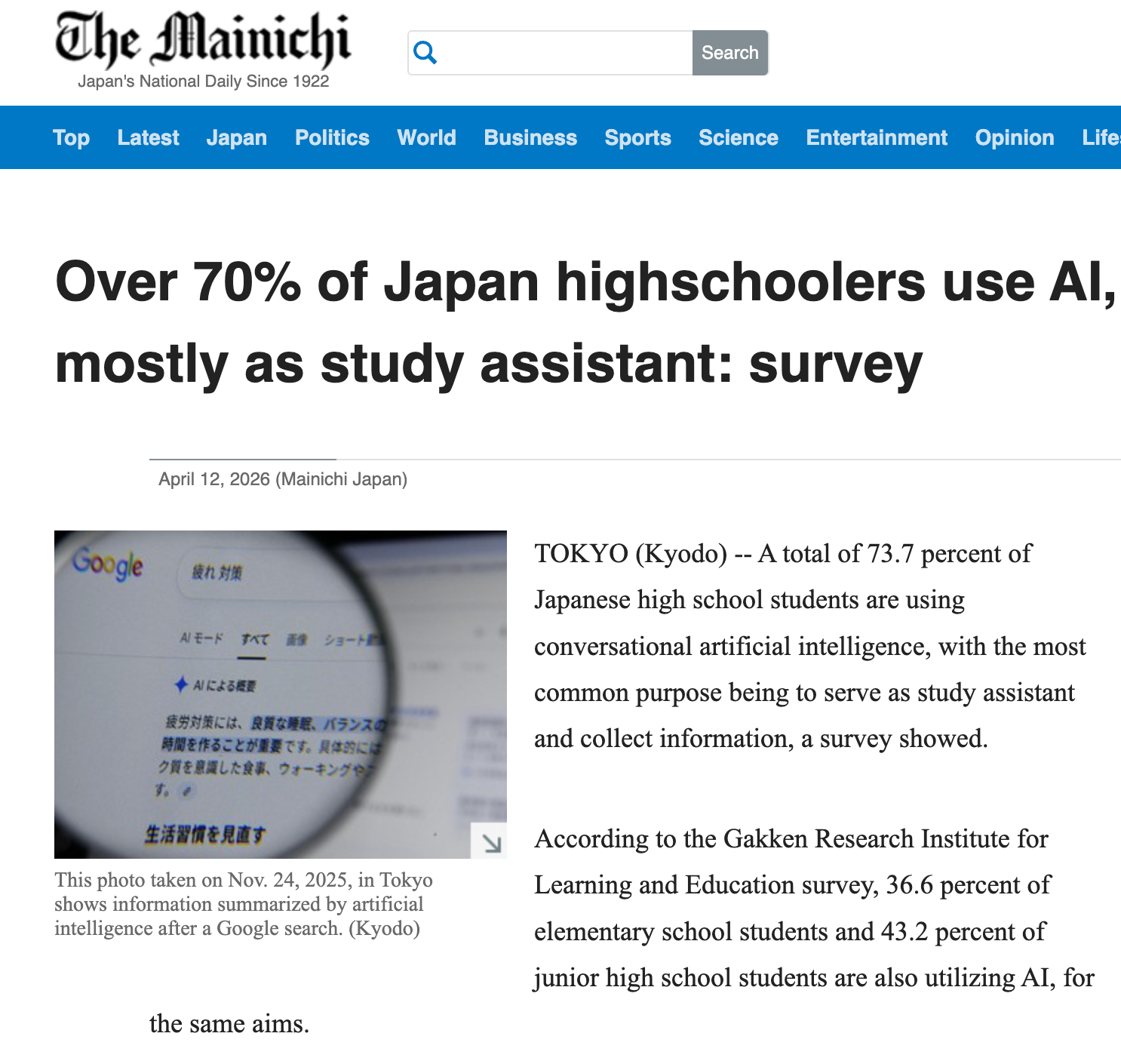
73.7% of Japanese high schoolers use AI, but weaker thinking
Whether you're a parent, an educator, or an organization building the next generation of talent, the signal here is clear. Here's what to do with it:

Source: Gakken Research Institute for Learning and Education
Study: Online survey, January 2026
Key Findings:
- 73.7% of Japanese high school students use conversational AI compared to 43.2% of junior high students and 36.6% of elementary students
- The top uses for high schoolers: 42.3% use AI to help with studying and homework, 26.0% to find information
- Elementary students use AI differently 44.0% for finding information, 32.6% for study help, and 23.7% to create illustrations and images
- When asked how AI affected their thinking ability, the most common response across all ages was "no particular change" but high schoolers stood out: they were more likely to say their thinking had weakened than strengthened
- Elementary and junior high students were more likely to report their thinking had improved, the inverse pattern of high schoolers
- A separate January 2026 survey of 1,200 students found nearly 80% of junior and senior high school students use generative AI "frequently" or "occasionally" and roughly 1 in 5 relies entirely on AI to provide answers or perform calculations
- 49.9% of girls use AI for advice or conversation, more than double the rate of boys (23.0%)
Risks & Advantages:
This data points to something organizations and parents need to take seriously. The students using AI the most are high schoolers, the ones with the highest cognitive demands...
And they are the ones most likely to feel their thinking getting weaker. That's not a coincidence. That's the Human Edge risk made visible in real time: the more you offload thinking to AI, the less practice your brain gets doing it itself.
The younger students reporting cognitive improvement are likely using AI more exploratorily, such as for images, ideas, conversation. The older ones are using it to replace the hard work of thinking through problems. That distinction matters enormously. How you use AI determines what it does to your brain.
The Competitive Advantage:
Whether you're a parent, an educator, or an organization building the next generation of talent, the signal here is clear. Here's what to do with it:
- Use AI to enhance thinking, not skip it. The students getting the most out of AI are using it for hints and structure, not to hand over the answer. That's the model worth building on.
- Watch for the replacement pattern. The moment AI goes from "help me think through this" to "give me the answer," cognitive offloading begins. One in five students is already fully reliant. That habit doesn't disappear when they enter the workforce.
- AI literacy isn't just knowing how to prompt. It means understanding what AI is doing to your thinking while you use it, and building the discipline to stay in command of your own judgment.
- The younger the user, the earlier the habits form. Organizations inheriting this generation will need to actively rebuild the independent thinking skills that AI-dependent studying quietly erodes. That's not alarmism, it's workforce planning.