76% of Marketers Say This AI Shift Boosted Their Results
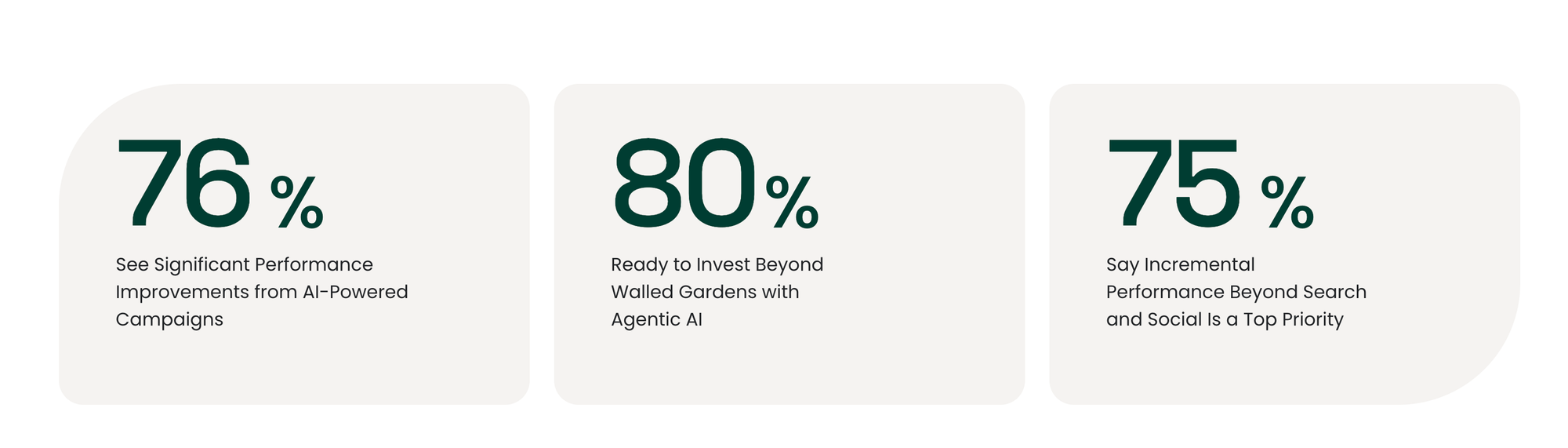
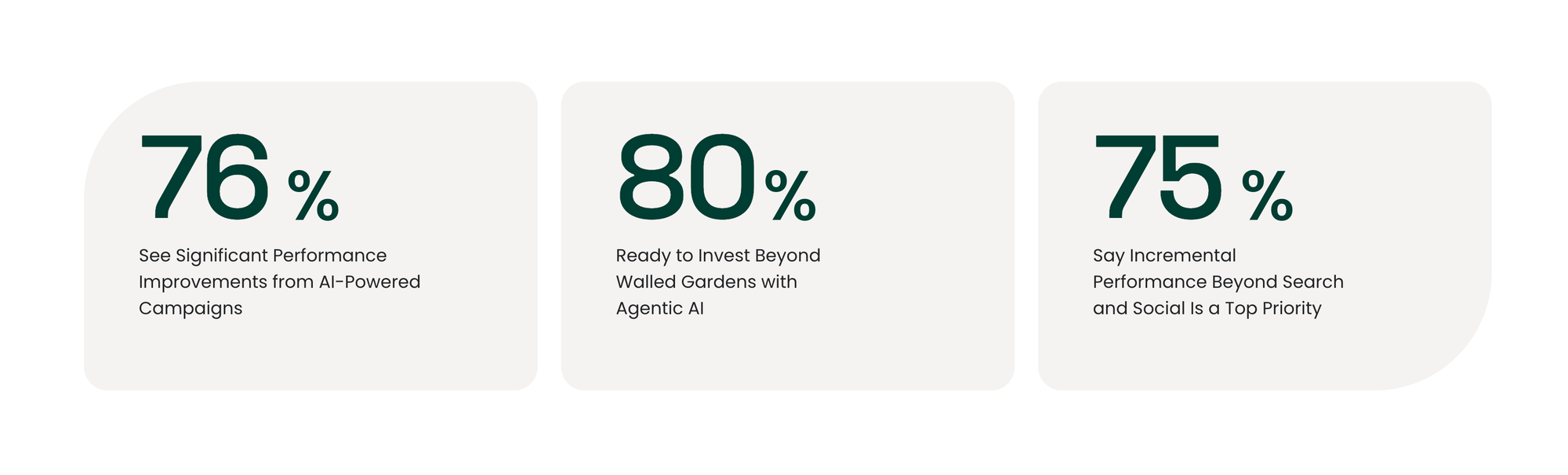
76% of marketers in the study say their best AI‑powered campaign tool gave them a moderate or significant boost in performance. In plain terms, more than three out of four are not just testing this stuff; they’re seeing it work. Only 1% said there was no impact at all.

A few years ago, most marketers were still moving knobs and sliders by hand. They watched dashboards, nudged bids up or down, and tried to guess which channel might bring in the next wave of customers. Today, a quiet shift is happening: more of that work is being handed over to software that makes decisions on its own, in real time, across huge numbers of ads and placements.
A recent study called “The Agentic Advantage in Performance Marketing” looks at how far this shift has gone, and what it means for businesses that rely on digital advertising to grow. The survey asked 200 senior marketers in the US and UK, mostly from mid‑ to large‑sized companies in eCommerce, finance, automotive, and health. These are people who manage serious ad budgets every month, and their answers tell a simple story: when they lean into AI‑driven campaign tools, most of them see better results.
The simple stat that stands out
The number that jumps off the page is this: 76% of marketers in the study say their best AI‑powered campaign tool gave them a moderate or significant boost in performance. In plain terms, more than three out of four are not just testing this stuff; they’re seeing it work. Only 1% said there was no impact at all.
Most of these gains are coming from tools many business owners have heard of: Google’s Performance Max and Meta’s Advantage. In the study, 91% said they already use Performance Max at scale, and 88% said the same about Advantage. These systems take simple goals like “get more sales at this cost per purchase” and then automatically handle the heavy lifting of where to show ads and how much to bid. For many marketers in the survey, that shift from manual tweaking to goal‑based automation is the “AI shift” that boosted their results.
Why that matters if you run a business
If you’re a small or medium‑sized business owner, there are two important takeaways here. First, you’re not alone if you feel like your search and social ads are hitting a ceiling. In the study, 74% of respondents said they put at least a quarter of their performance budget into paid search, and 67% said the same for paid social. That’s a lot of money chasing the same people in the same places.
Second, the marketers in this survey are clear about what they want next: new ways to grow beyond those crowded channels. Three‑quarters of them say finding a channel that can deliver extra results beyond search and social is very or extremely important. They’re especially interested in the “open web” – the wider world of websites outside the big platforms – but only if they can manage it with the same kind of smart automation they enjoy in Google and Meta.
The open web: a big opportunity still underused
Right now, the open web mostly gets a middle‑of‑the‑road budget share. Many marketers put only 10–25% of their performance spend there, and only 4% currently invest heavily in it (25% or more of their budget). But when asked what they would do if there were strong AI tools for the open web, the answers change.
In that “what if” scenario, 99% of respondents say they would allocate some of their budget to the open web, with an average of 24% of their entire performance budget. About half say they would put 11–25% there, and more than a third say they would go up to 50%. In other words, if the tools are good enough, many marketers are ready to move a meaningful slice of money away from just search and social and into new places where they can reach fresh customers.
What’s holding them back
If this all sounds so promising, why isn’t everyone already doing it?
The study answers that too, and the reasons are very human.
The biggest barrier named is “difficulty integrating these AI tools into existing workflows,” chosen by 54% of respondents. The more money a company spends each month, the more this becomes a headache: large advertisers with over 1 million in monthly budget are the most likely to say integration is their number one problem.
When it comes to the open web specifically, marketers also point to messy realities: too many vendors to manage (74%), trouble tying results together with unified measurement (71%), and worries about brand safety (54%). Only a small minority say they don’t believe the open web can bring in new users or better performance at all. So the main issue isn’t that people think it won’t work; it’s that running it well, and proving it works, can be complicated.
How open they are to changing their budget
Even with those challenges, the appetite for change is strong. In the study, 81% of marketers say they would increase their open‑web investment if it offered the same kind of automated, goal‑driven systems they already trust in search and social. Almost half “strongly agree” with that statement.
The push is even stronger among senior leaders and big spenders. Among those with the highest monthly budgets, and among VPs, the share of people who strongly agree they’d move more money to the open web is especially high. For a smaller business, that’s a useful signal: bigger competitors are already preparing to shift once the tools are ready. If you wait too long, you may find yourself trying to catch up in channels where they have already learned what works.
Who ran this study, and what’s their interest?
The report was commissioned by Realize, a company that is building an AI‑driven performance platform for the open web. Their product aims to bring the same kind of automated, goal‑based campaign management you see in Google’s Performance Max and Meta’s Advantage, but applied across websites beyond those walled gardens. The survey itself was carried out online by an independent research firm, Global Surveyz Research, with 200 respondents in March 2026.
It’s important to be clear about the potential conflict of interest: Realize benefits if marketers believe that agentic AI is the future of performance marketing and that the open web is a big, underused growth channel. The way the questions are framed and the way the results are presented may be influenced by that goal. That doesn’t mean the numbers are wrong, but readers should keep in mind that the sponsor has something to gain if the story is convincing.
What this means for a small or medium business
For a smaller business, you don’t need to adopt every new tool overnight. But this study suggests a direction of travel you probably can’t ignore. Larger marketers are already seeing better results by letting AI handle more of the day‑to‑day optimization of their campaigns, especially in search and social. They are also actively looking for new places to grow once those channels start to level off.
If you rely heavily on just one or two ad platforms, this may be a good moment to ask two simple questions:
- Are there smarter tools available inside the platforms you already use that could help you get more out of the same budget?
- As tools for the wider web mature, do you want to be late to that party, or learning early while the competition is still figuring it out?
Reading the full “Agentic Advantage in Performance Marketing” report won’t give you a magic formula, but it will show you how marketers with bigger budgets are thinking about the next few years of digital advertising. For a business owner, that glimpse into where the market is heading can be just as valuable as any single tip or tactic.
Looking at this as a business owner yourself, what part of this story feels most relevant to you right now: getting more results from the same ad budget, or finding new channels beyond search and social where your next customers might be?