78% of Americans use AI, but only 18% trust it to make money decisions alone
TD surveyed 2,504 U.S. adults in early 2026 and found that AI has fully crossed into the mainstream.
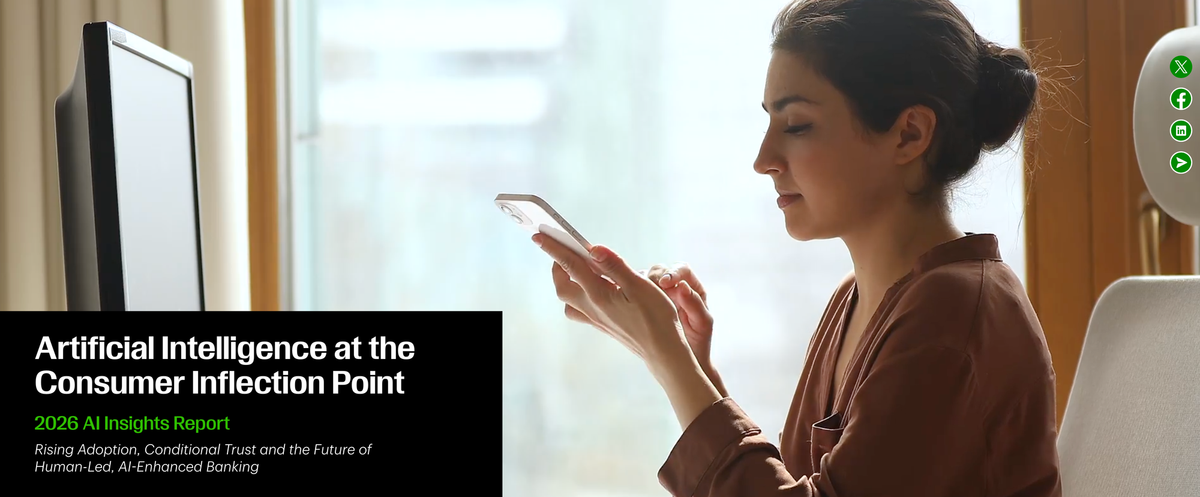
Picture this: you’re on the couch, trying to decide whether to pay off a credit card or put more into savings. You open an AI assistant, type in your balances, and ask what to do. It gives a confident answer in two seconds.
Now imagine doing the same thing on a call with your bank, but the voice on the other end is clearly a bot—not a human who can be held accountable if something goes wrong. You probably feel very differently about those two situations. That gap between using AI and trusting AI is exactly what TD’s 2026 U.S. AI Insights Report is about.
What the study actually found
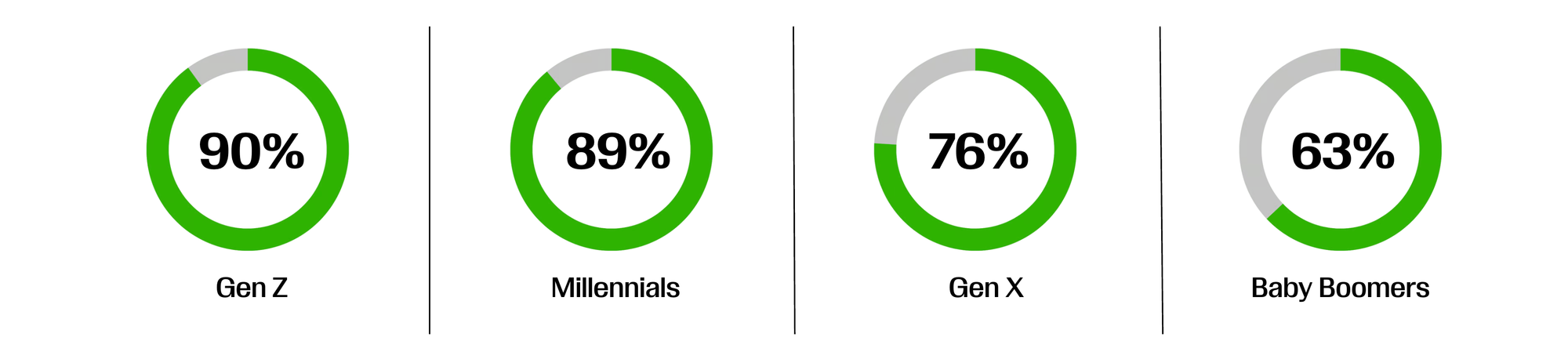
TD surveyed 2,504 U.S. adults in early 2026 and found that AI has fully crossed into the mainstream. About 78% of Americans say they use AI‑powered tools in daily life, and 67% say they’re more proficient with AI than they were a year ago. Usage is especially high among Gen Z and Millennials, but even Gen X and Boomers show majority adoption.
The biggest jump is in personal finance. In 2025, only 10% of consumers said they used AI to help manage their money; in 2026, that number jumped to 55%. People are using AI to track spending, set goals, and manage day‑to‑day decisions far more than before.
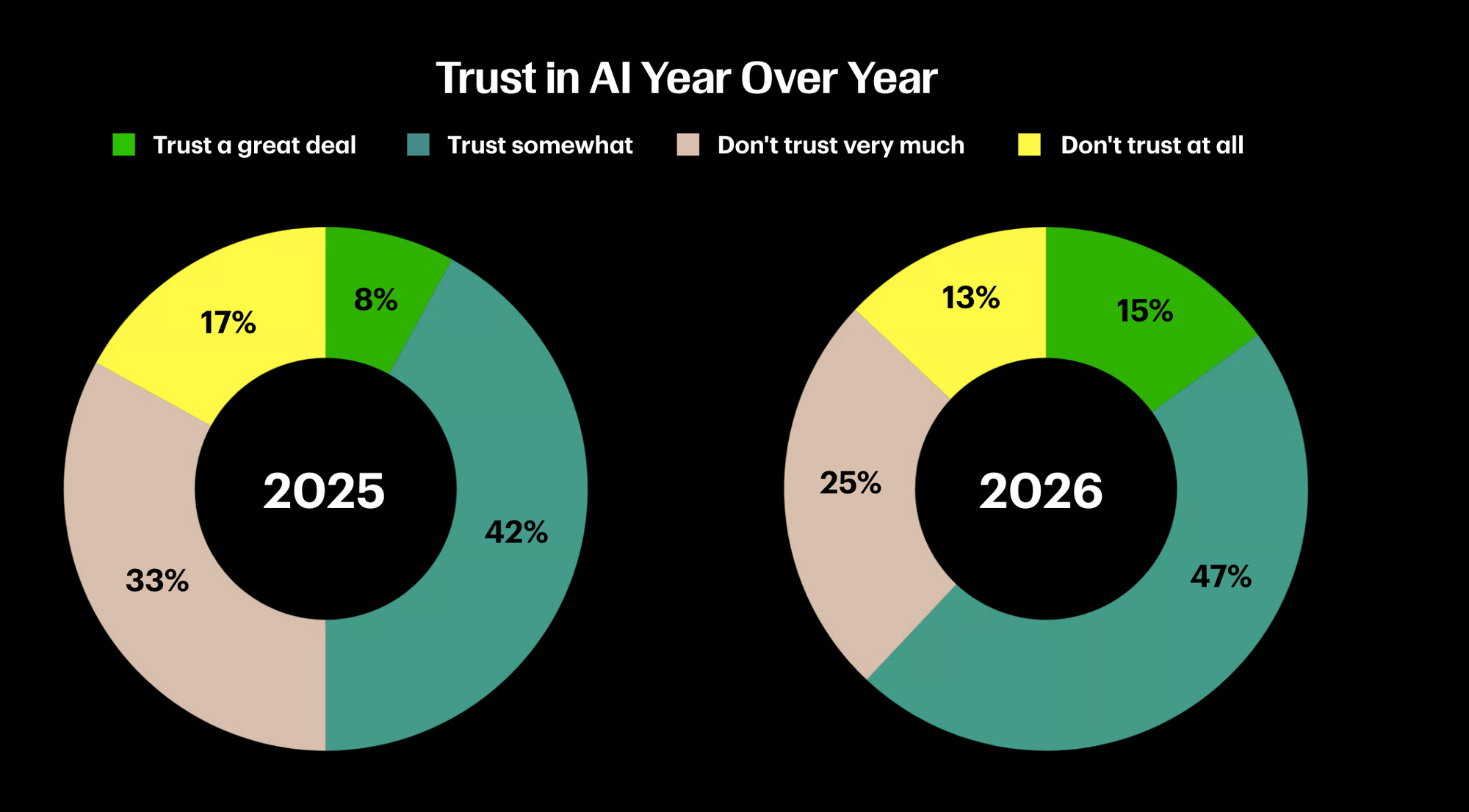
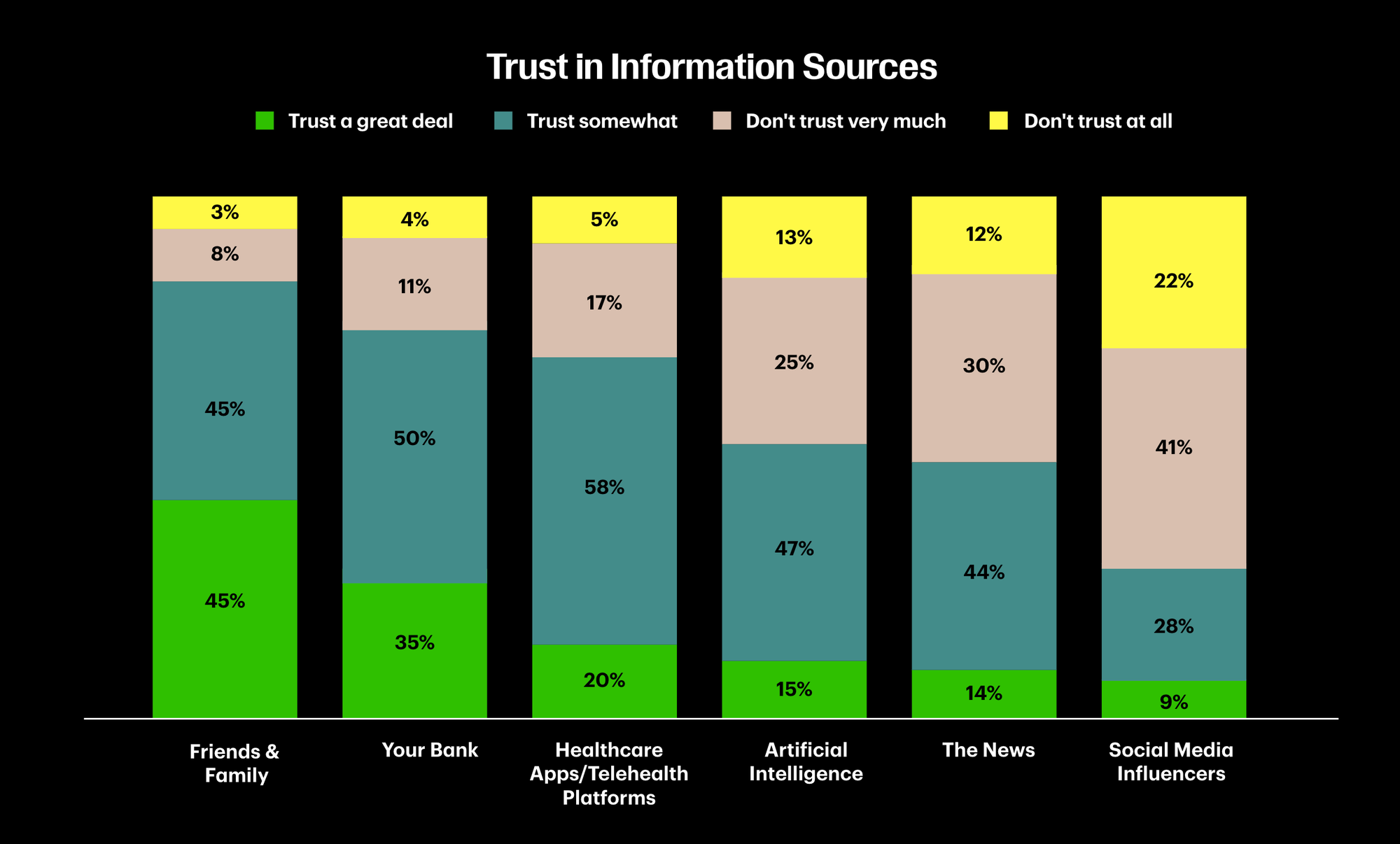
Trust is not keeping up with usage. Only 18% of respondents say they would trust AI to make financial recommendations entirely on its own, even as most say they trust AI to provide generally honest or useful information. By contrast, 85% say they trust their bank, and roughly 90% trust friends and family—showing that AI still trails familiar human sources by a wide margin.
Consumers are choosy about where AI shows up. They are most comfortable when AI works “behind the scenes” on things like fraud detection, spending tracking, and credit scoring, and less comfortable when AI is framed as the decision maker for complex, high‑stakes choices. When interacting with their bank, 8 in 10 people want a human involved at some point, either supported by AI or taking over from an AI assistant.
At work, AI is also becoming standard. About 83% of employed respondents use AI tools for their jobs, up sharply from the previous year, and 71% say AI gives them a competitive edge over others in similar roles. Many report being less worried than before about AI taking their jobs and more focused on how to use it well.
Why this matters for human life (cognition, wellbeing, social fabric)
From a human perspective, this report shows a subtle but important shift: people are folding AI into everyday routines without fully handing over their judgment. That means AI is shaping how we think about money, risk, and planning, but most people still want a human “anchor” they can rely on for big decisions.
There’s also a cognitive load angle. As AI takes over low‑level tasks—tracking spending, generating options—people may feel more capable but also more dependent on tools that they don’t fully understand. The fact that trust in banks and close relationships remains higher than trust in AI suggests that people still see human relationships as the core safety net, even as they lean on AI for speed and convenience.
Why this matters for work
For work, the study reinforces that AI is becoming table stakes. If 83% of workers are already using AI and 71% feel it gives them an advantage, then not using AI starts to look like a disadvantage over time. The narrative is shifting from “Will AI take my job?” to “Will someone who uses AI better than me take my job?”
But trust dynamics still matter. Workers are comfortable letting AI support research, drafting, analysis, and routine tasks, while expecting humans—managers, experts, themselves—to own final decisions. For leaders, that means the real work is designing workflows where AI augments human judgment and making clear who is ultimately accountable when AI‑supported decisions go wrong.
Why this matters for education
Even though this is a banking‑sponsored study, the signals for education are strong. If most adults now use AI and feel more proficient than a year ago, then students and future workers are entering classrooms expecting that AI is part of how learning and work happen. The gap between heavy usage and cautious trust is a cue that “AI literacy” can’t just be about how to prompt—people also need to learn when to lean on AI and when to question it.
The personal finance numbers are especially relevant for education. Moving from 10% to 55% AI use in money management in one year means students (and their families) are more likely to get financial advice from AI tools before they ever talk to a human advisor. Teaching critical thinking, risk awareness, and how to evaluate AI‑generated financial guidance will matter just as much as teaching budgeting basics.
If you run a business…
- Treat AI as expected infrastructure, not a gimmick. With most consumers and employees already using AI, the differentiation is how you use it—especially around safety, clarity, and human control.
- Design “human‑led, AI‑assisted” experiences. Consumers are clearly most comfortable when AI handles efficiency and pattern‑spotting, and humans handle nuance, emotion, and accountability.
Make sure you’re explicit about who is responsible when AI‑supported decisions affect customer outcomes, and communicate that in simple language.
If you’re an educator…
- Assume your learners are already using AI, even if they don’t admit it. The usage and proficiency jumps suggest AI is part of how people research, write, and plan outside the classroom.
- Use that to teach discernment, not avoidance. Frame AI as a tool that can assist with understanding, practice, and planning, while building habits like cross‑checking, asking “What assumptions is this making?”, and knowing when to ask a human expert instead.
You can also borrow the “behind‑the‑scenes AI, human‑led decisions” model from banking: let AI speed up feedback and support, but keep human educators front and center on grading, mentoring, and big calls.
If you lead a university, district, or large organization…
- Plan for AI as default, trust as the bottleneck. Policies that ignore AI use will be out of touch with the realities this study documents. Focus on where AI is welcome, where it needs extra guardrails, and where it should be off‑limits.
- Be transparent about your own AI use. Just as banking customers want to know when AI is in the loop, students, staff, and community members will want clarity on how AI is used in admissions, grading, hiring, or student support.
Making data protection, fairness, and human accountability explicit is likely to matter as much for institutional trust as it does for banks.
Limits and conflicts of interest
This is TD’s second annual AI Insights Report, funded and published by a major bank that benefits from a “human‑plus‑AI” narrative. The survey is online and opt‑in, which tends to tilt toward more digitally comfortable respondents; people who are offline or strongly resistant to tech may be under‑represented.
Because TD is in financial services, the questions and framing are naturally tilted toward banking scenarios and trust in banks, not, say, independent fintechs or non‑bank platforms. Still, the large sample and the fact that the patterns match other public surveys (high usage, lower trust, preference for hybrid models) make the core signals worth paying attention to.
Questions to ask in your organization
- Where are we already assuming that “more AI” automatically equals “better,” and where do we need to protect space for human judgment?
- In our customer or student journeys, which steps are “safe” for AI to handle behind the scenes, and which moments really demand a human face and name?
- How clearly do we explain to people when AI is involved, what data it uses, and who is accountable if something goes wrong?
- What skills (critical thinking, prompt design, verification) do our teams or students need so they’re not just using AI, but using it wisely?
- How will we measure whether AI is improving wellbeing, learning, and trust—not just efficiency?
If you’re exploring how to adopt AI safely while protecting human thinking and morale, this is exactly the kind of tension—between usage, trust, and human judgment—that Kalu Agency is built to work on.
To check your understanding: if you had to turn one stat from this study into a headline for leaders in your organization, which number would you pick, and what story would you tell around it?